Ontology Description
The figure below depicts the taxonomy of individuals defined by the AlpineBits® DestinationData Ontology:
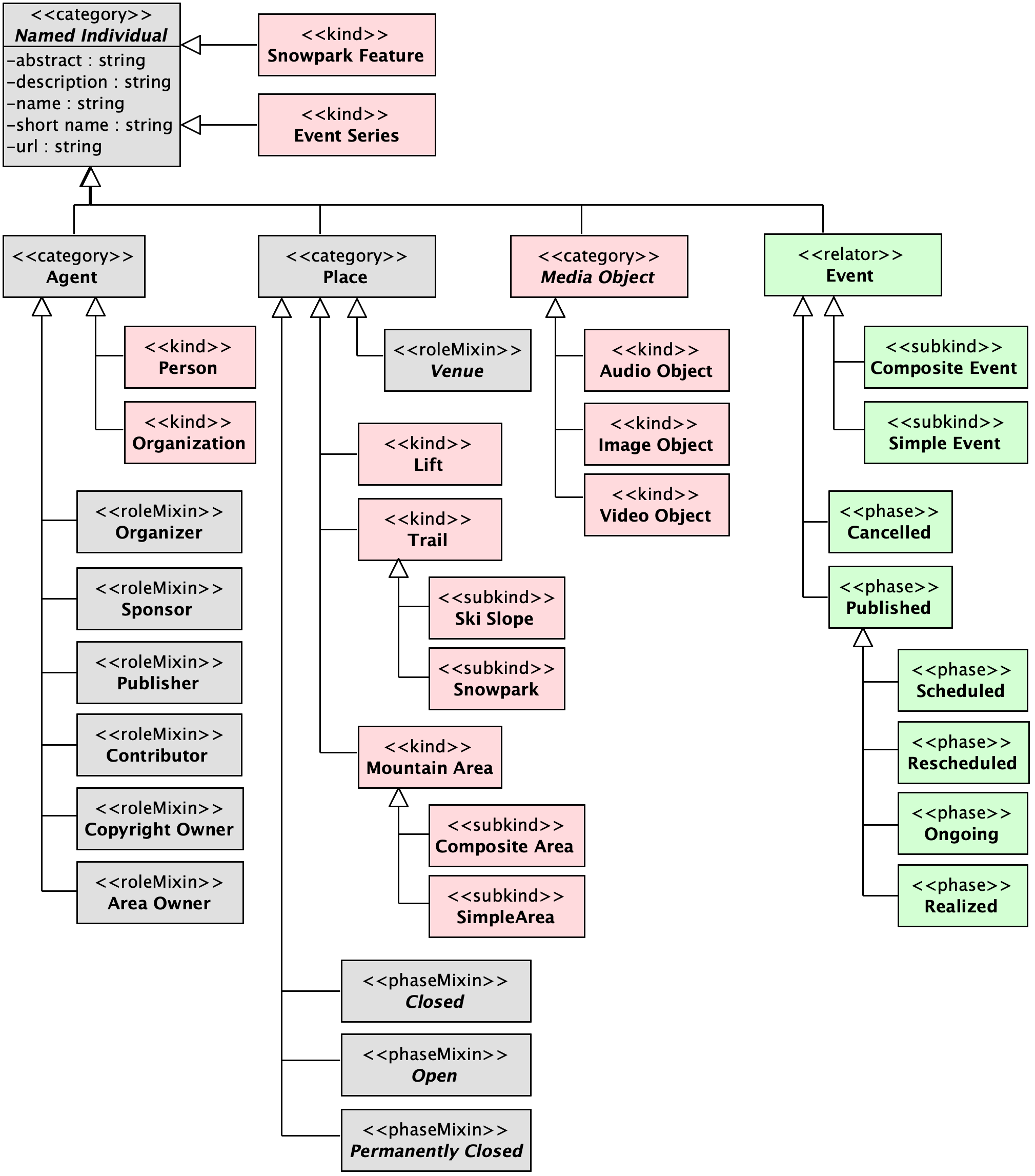
All classes of individuals in the AlpineBits® DestinationData Ontology specialize Named Individual.
Named Individual have the following properties: abstract, a short description of the individual; description, a description of the individual more thorough than an abstract; name, the name of the individual; short name, the short version of the name of the individual (e.g., an abbreviation); url, a link that leads to additional information regarding the individual.
The additional classes of individuals in the figure above are described in the following sections.
1. Agent
An individual who bears mental attitudes and is capable of performing actions and perceiving events.
An Agent is either a Person, such as Albert Einstein, Marie Curie, Lionel Messi, and Serena Williams, or an Organization, such as Apple, Facebook, the AlpineBits Alliance, and Free University of Bozen-Bolzano.
An Agent can play several roles within the touristic domain, namely the Organizer, Sponsor, Publisher, or Contributor of an event, the Copyright Owner of a media object, and the Area Owner of a mountain area.
A fragment of the ontology depicting Agent and its properties is presented below:
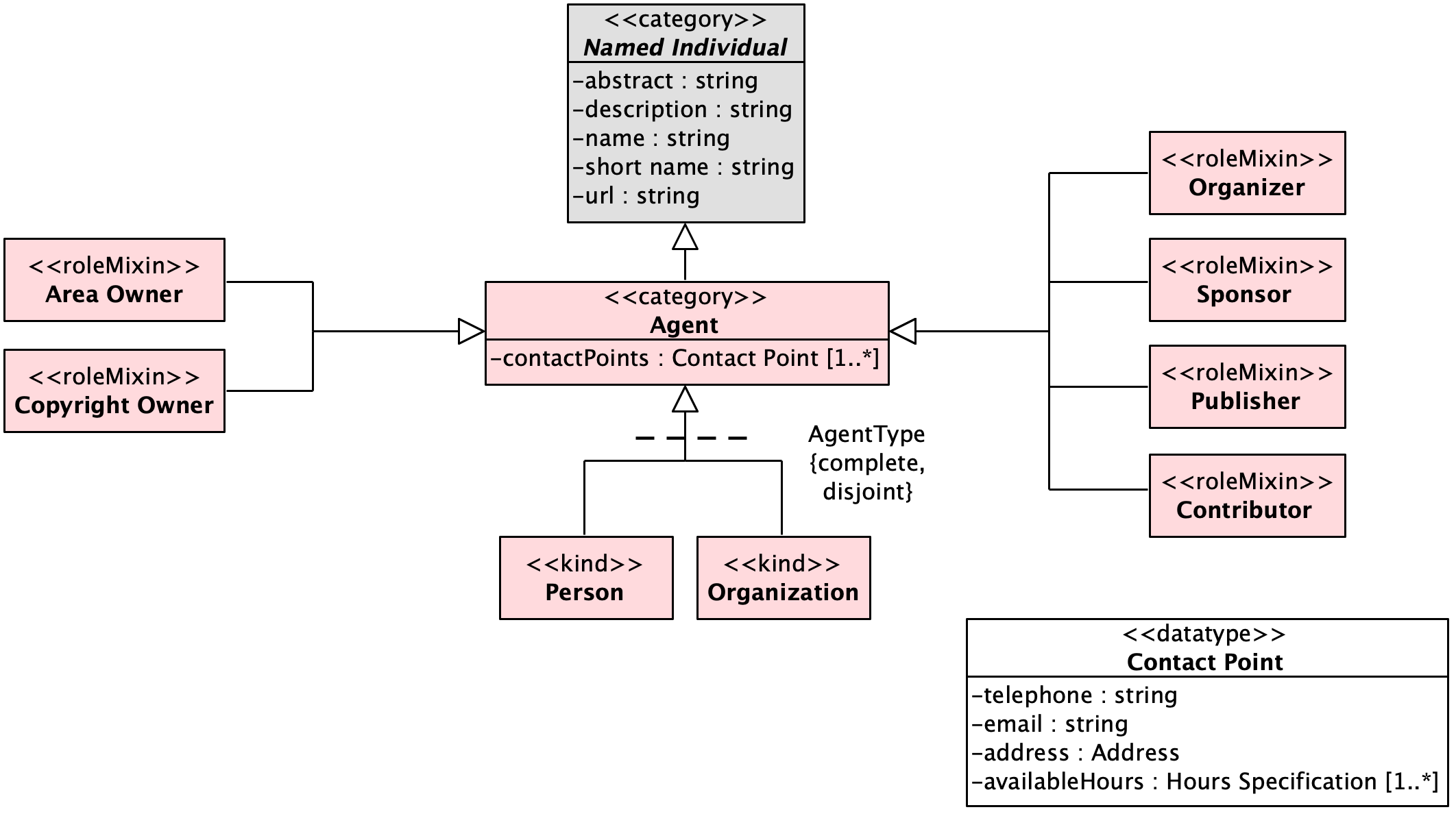
In addition to the attributes inherited from Named Individual, Agents have a property named contactPoints, which identify a list of Contact Points one can use to get in touch with an Agent.
A Contact Point informs how to contact an Agent, namely its email address, telephone number and physical address, but also when to do it by means of the availableHours property.
Contact Point information is relevant for tourists who want to contact the owner of a mountain area to know about its slopes conditions, or for customers who want to contact an event’s organizer about ticket prices.
2. Media Object
An object that materializes creative works into a digital format to enable processing and sharing.
Three disjoint types of Media Objects are identified in the ontology, namely Audio Object, e.g. an audio file containing a recording of a song, Image Object, e.g. an image file depicting a lift, and Video Object, e.g. a video file containing a recording of a musical performance.
A fragment of the ontology depicting Media Object, its properties, and subtypes is shown below:
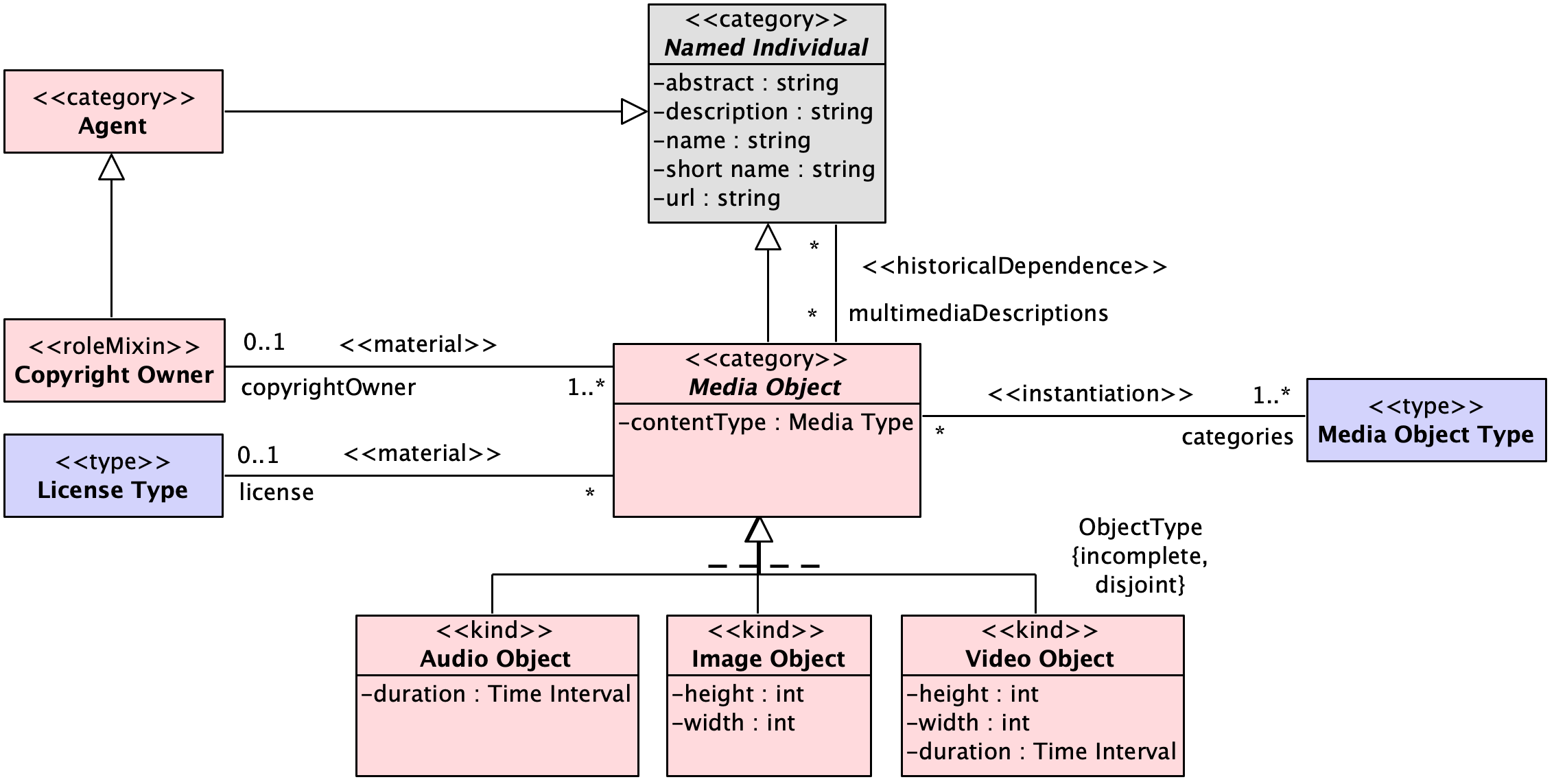
In addition to the attributes inherited from Named Individual, Media Object is characterized by contentType, which refers to the Media Types (formerly known as MIME Types) defined by the Internet Assigned Numbers Authority (IANA).
A Media Object, or more precisely, the creative work embedded in it, may be owned by agent, termed the Copyright Owner. Additionally, it may be available for reuse by others according to a License Type, such as the Creative Commons 1.0 Universal.
A Media Object often depicts a Named Individual, such as events and event venues, but also lifts, trails, and snowparks. This depiction is captured in the ontology by means of the historical dependence between Named Individual and Media Object.
3. Place
An individual that has a fixed physical location and can be localized within a Global Positioning System (GPS) (adapted from Schema.org). Examples of places include a town square, a stadium, a trail, a gas station, and a park.
A Place may go through two phases: In Operation and Permanently Closed. The first classifies places that are functioning, regardless if they are currently open or not. The second classifies those that have terminated its operations. The sub-phases of In Operation identify current state of a place according to its opening hours, i.e. if its open or closed at a given point in time.
Place specializes Named Entity and thus, inherit all of its attributes.
Place is additionally characterized by the attributes address, howToArrive, and openingHours. address is the physical address of a place, howToArrive are instructions on how to arrive at a place, and openingHours identify when a place is (or should be) open.
A Place may be physically connected to other places and give access to them. For instance, the Falzeben Gondola at Merano 2000 gives access to the Falzeben I and Wallpach slopes.
In the ontology, this relation is captured by the connections self-type association defined for Place
A fragment of the ontology centered around the Place concept, its properties, and subtypes is shown below:
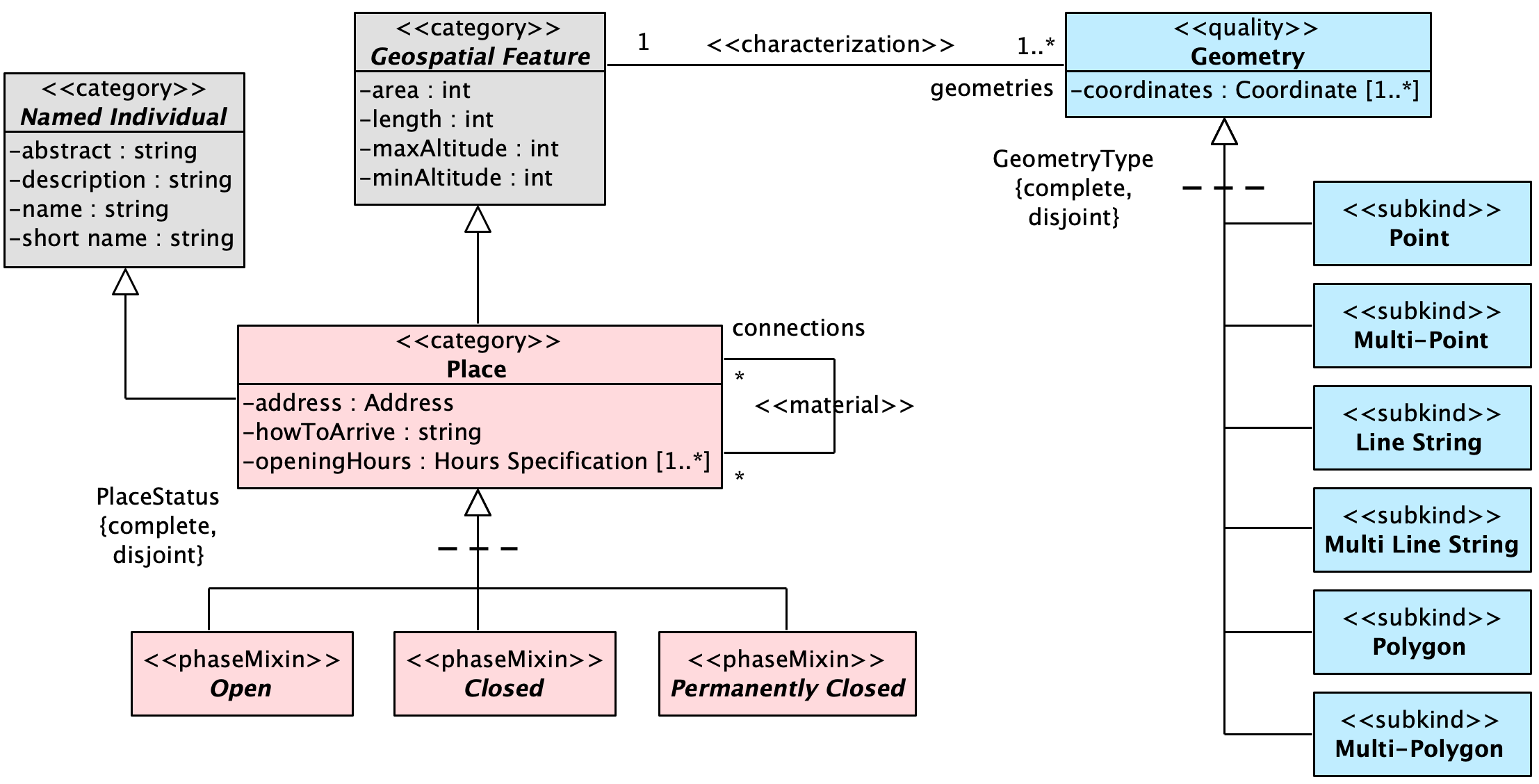
The GPS information that can be associated to a Place is represented by means of the Geometry quality, which is sub-classified into the following subtypes according to its geometrical shape: Point, Multi Point, Line String, Multi Line String, Polygon, and Multi Polygon.
Instances of Geometry must instantiate exactly one of the aforementioned subtypes.
The coordinates attribute in the Geometry class is the list of points that compose the geometry.
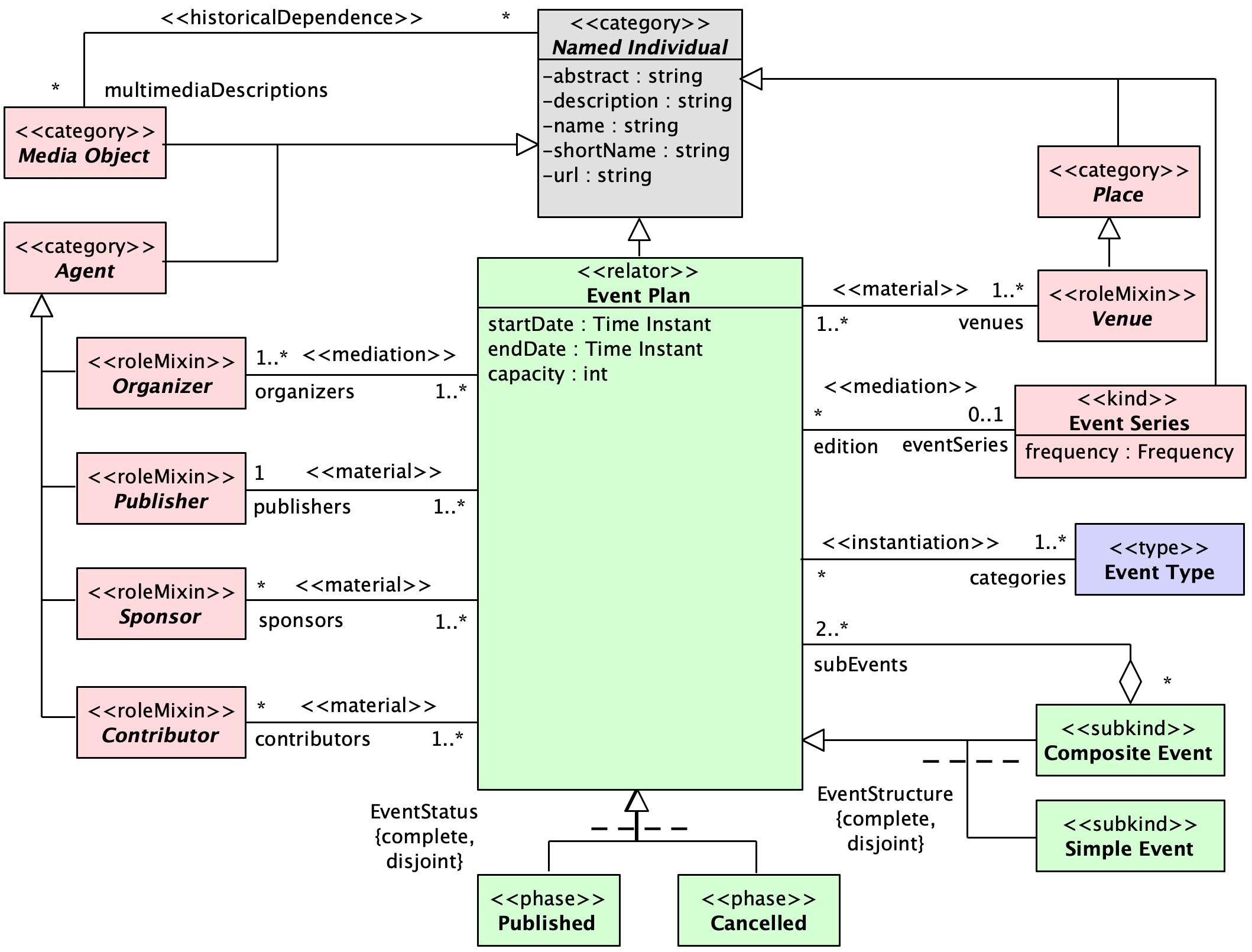
4. Event, Event Series and Venue
An Event is something that is planned to happen at a particular place and time, organised by an agent for a particular purpose, and is of interest to a general audience (adapted from the Core Public Event Vocabulary).
Examples include the Südtirol Jazz Festival 2018, the South Tyrol Free Software Conference organized in 2019, the Bolzano Christmas Market of 2019, and a Serie A match between Juventus and Napoli.
In addition to the attributes inherited from Named Individual, an Event has: a startDate, which describes when the event is supposed to start; and endDate, which describes when the event is supposed to end; and capacity, which describes how many people can attend the event.
An Event happens at one or more places, which are dubbed its Venues. For instance, the venue of Bolzano Christmas Market in 2019 was Piazza Walther.
An Event may involve several Agents, i.e. persons or organizations, in different ways. An Organizer plans the event and is legally responsible for it; the Publisher provides data about it; a Sponsor supports its organization, usually by making financial contributions; and a Contributor actively participates in the event, such as a presenter, a singer or an expositor.
Events may be composed of smaller events. For instance, the Südtirol Jazz Festival 2019 was composed of over 30 individual concerts. This type of event is classified as a Composite Event in the ontology, while those without sub-events are deemed Simple Events.
An Event is in one of two phases, namely Published and Cancelled. The former refers to those whose plans are or were valid, while the latter refers to those that have been cancelled.
Some Events are recurrently organized over time. The "template" for such events is called an Event Series. Examples include the Olympics, which is organized every 4 years, the Bolzano Christmas Market, which is organized every year, and the Food Truck Weekend, which is organized sporadically in Trento.
The frequency in which an Event Series is organized is captured in the ontology by the homonymous attribute.
A fragment of the ontology focused on the concepts of Event, Event Series, and Venue is shown below:
5. Mountain Areas
A Mountain Area is geographical region in which alpine sports and activities can be performed, such as skiing, snowboarding, climbing, and hiking.
Examples include Dolomiti Superski, located in South Tyrol, Italy, Zermatt Matterhorn, located in Switzerland, and St. Anton Arlberg, located in Austria.
An excerpt of the ontology regarding Mountain Area its relations and properties is shown below:
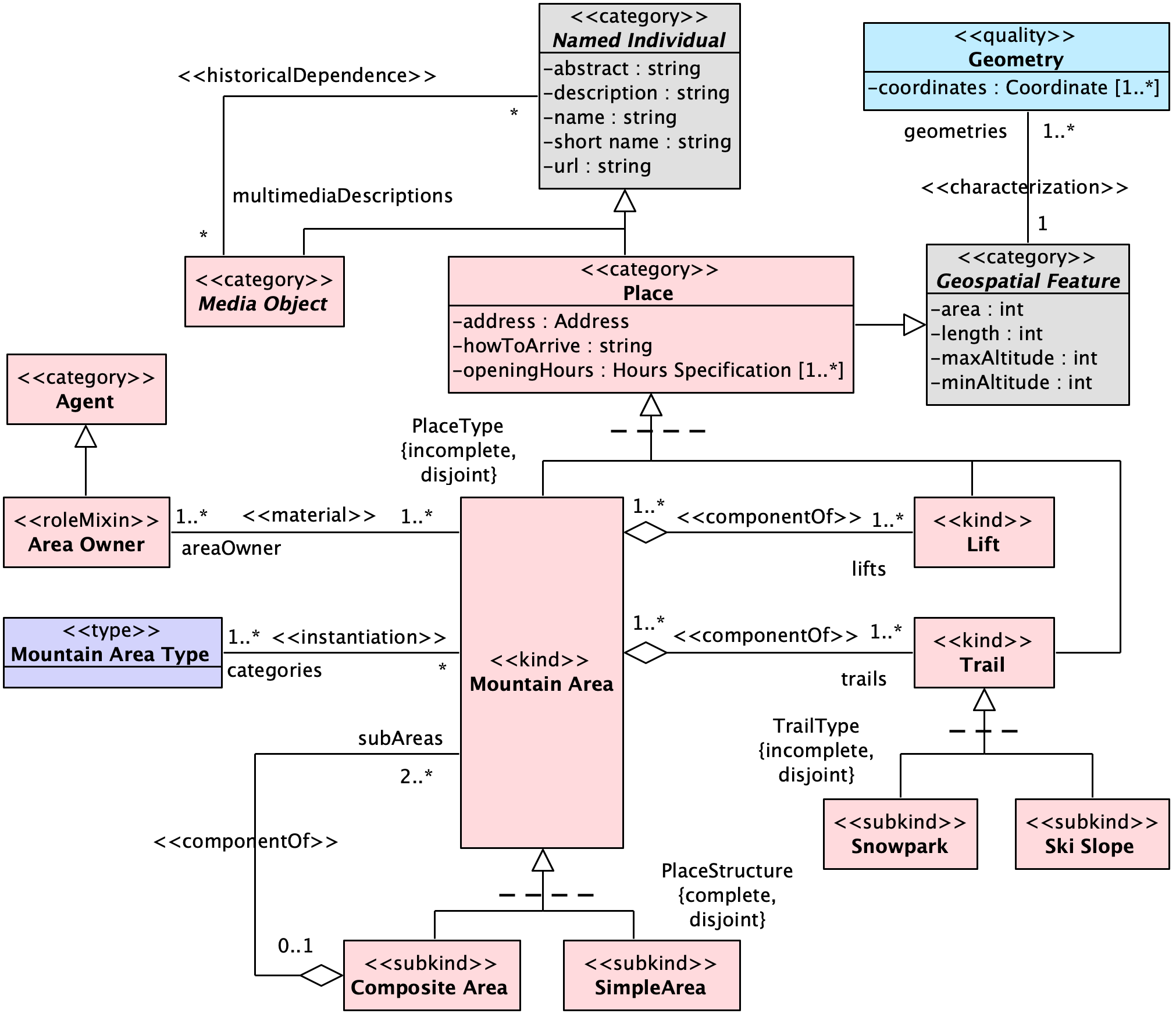
As a particular type of Place, Mountain Area inherit all of its attributes and relations, which include address and gps-related properties.
A Mountain Area are often very large areas that contain a wide number of other places. Among these, the ontology highlights the following two components types: Lift and Trail.
Mountain Areas may aggregate other mountain areas. This is the case of Dolomiti Superski and Ortler Skiarena, which aggregate several smaller areas in South Tyrol. In such cases, the broader area contains, by transitivity, every Lift, Trail, and Snowpark within its contained areas.
Note, the composition of mountain areas is:
-
irreflexive: an area cannot be composed by itself;
-
transitive: if area X is composed by area Y and area Y is composed by area Z, it implies that X is also composed by area Z;
-
antisymmetric: if area X is composed by area B, area B cannot be composed by area A.
A Mountain Area is usually owned by private organizations. For instance, the Merano 2000 area is owner by the company Merano 2000 Funivie Spa.
6. Trails, Snowparks, and Lifts
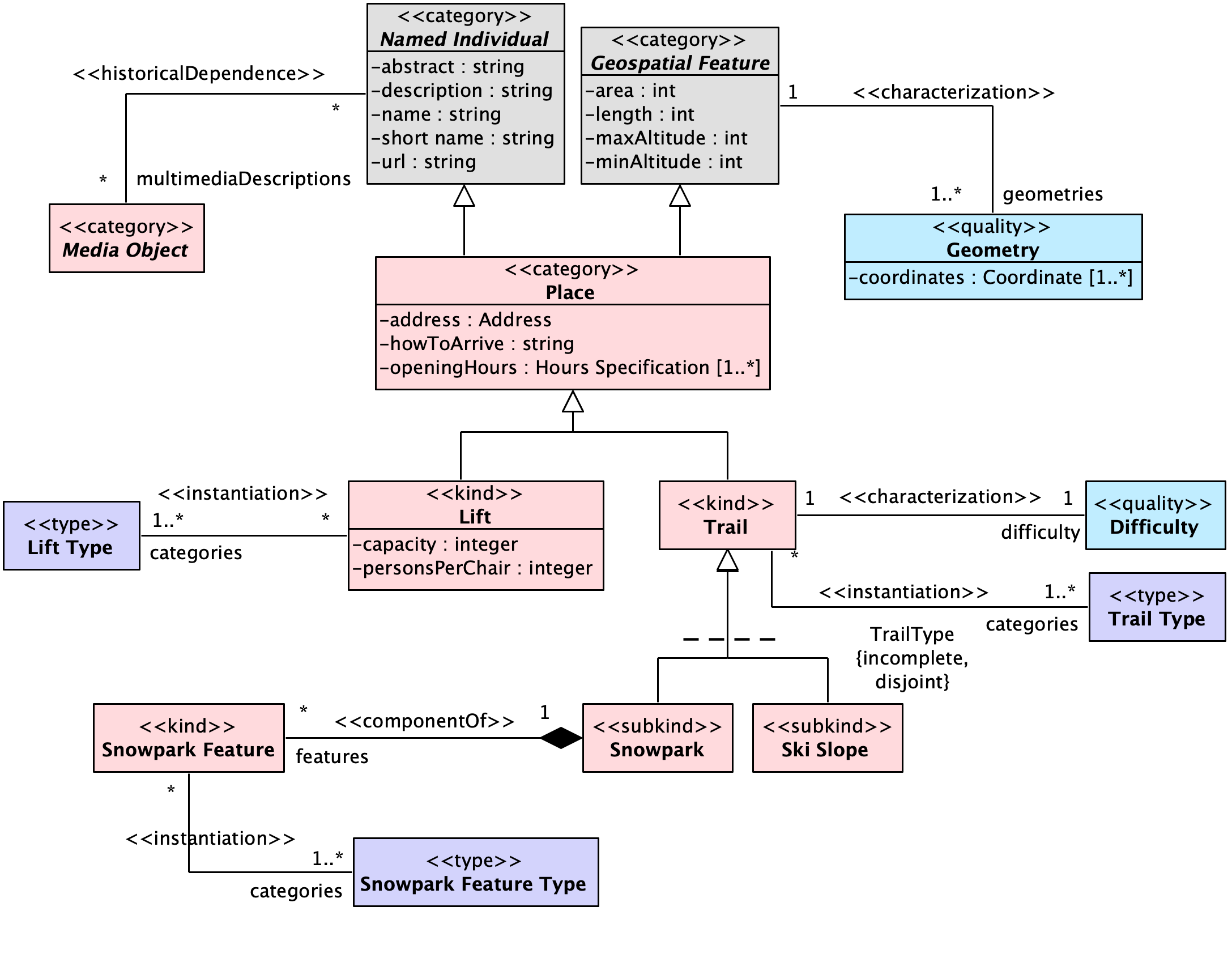
A Trail is physical path that supports the practice of some type of sport activity. It may be of several types, including ski slopes, snowparks, sledge slopes, hiking trails, cross-country ski trails, climbing trails and so on.
The complexity of skiing or snowboarding in a given Ski Slope is captured by the attributes european difficulty and american difficulty, each of which refer to the difficulty of the slope according to the regional scales.
A Snowpark is a particular type of Trail that is designed to allow skiers and snowboarders to perform free-style tricks by providing them with special features, such as jumps and rails.
The difficulty level of a Snowpark is captured by its homonymous attribute.
A Lift is a machine designed to transport people uphill, being often used to transport skiers in mountain areas. Lifts may be of several types, such as chairlifts, gondolas, and cableways.
An fragment of the ontology that formalizes Lift and Trail is presented below:
7. Snow Measurement
A relevant piece of information for alpine tourists during winter season are the snow condition of mountain areas and ski slopes. This is captured in the ontology by means of the Snow Measurement concept, a relator that describes the result of a measuring activity performed by an Agent, at a particular Place, in a given point in time (date).
An excerpt of the ontology describing Snow Measurement is show below:
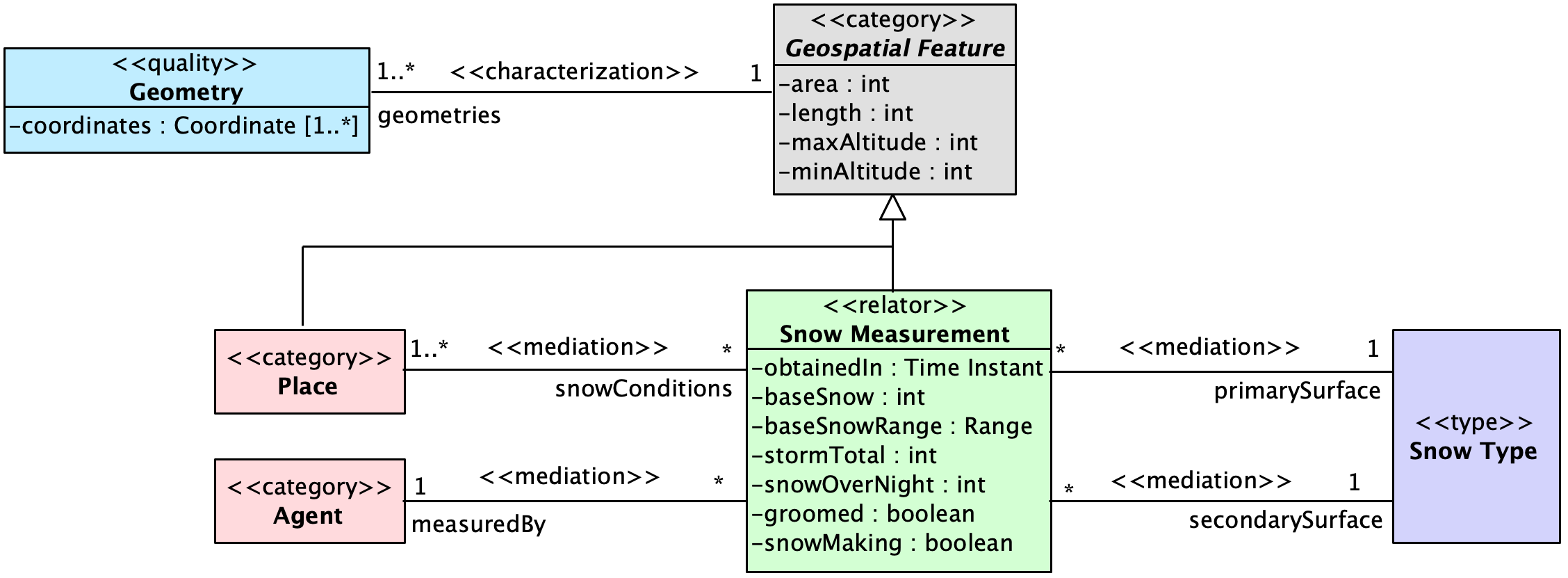
Note that Snow Measurement specializes Geospatial Feature. This means that its instances may be localized using GPS Geometries of any shape.
A Snow Measurement identifies the following descriptive properties:
-
baseSnow: the height of snow in the vicinities of the measurement location -
baseSnowRange: the variation of thebaseSnowmeasurement in the vicinities of the measurement location -
groomed: indicates whether or not the snow has been groomed in the vicinities of the measurement location -
primarySurface: the main type of snow found in the vicinities of the measurement location -
secondarySurface: the secondary type of snow found in the vicinities of the measurement location -
snowMaking: indicates whether or not the snow in the vicinities of the measurement location has been artificially produced -
snowOverNight: the height of snow accumulated in the previous night in the vicinities of the measurement location -
stormTotal: the height of snow accumulated from the last snow storm in the vicinities of the measurement location